



Détails du produit
On-Board Charging Matched to Your Battery
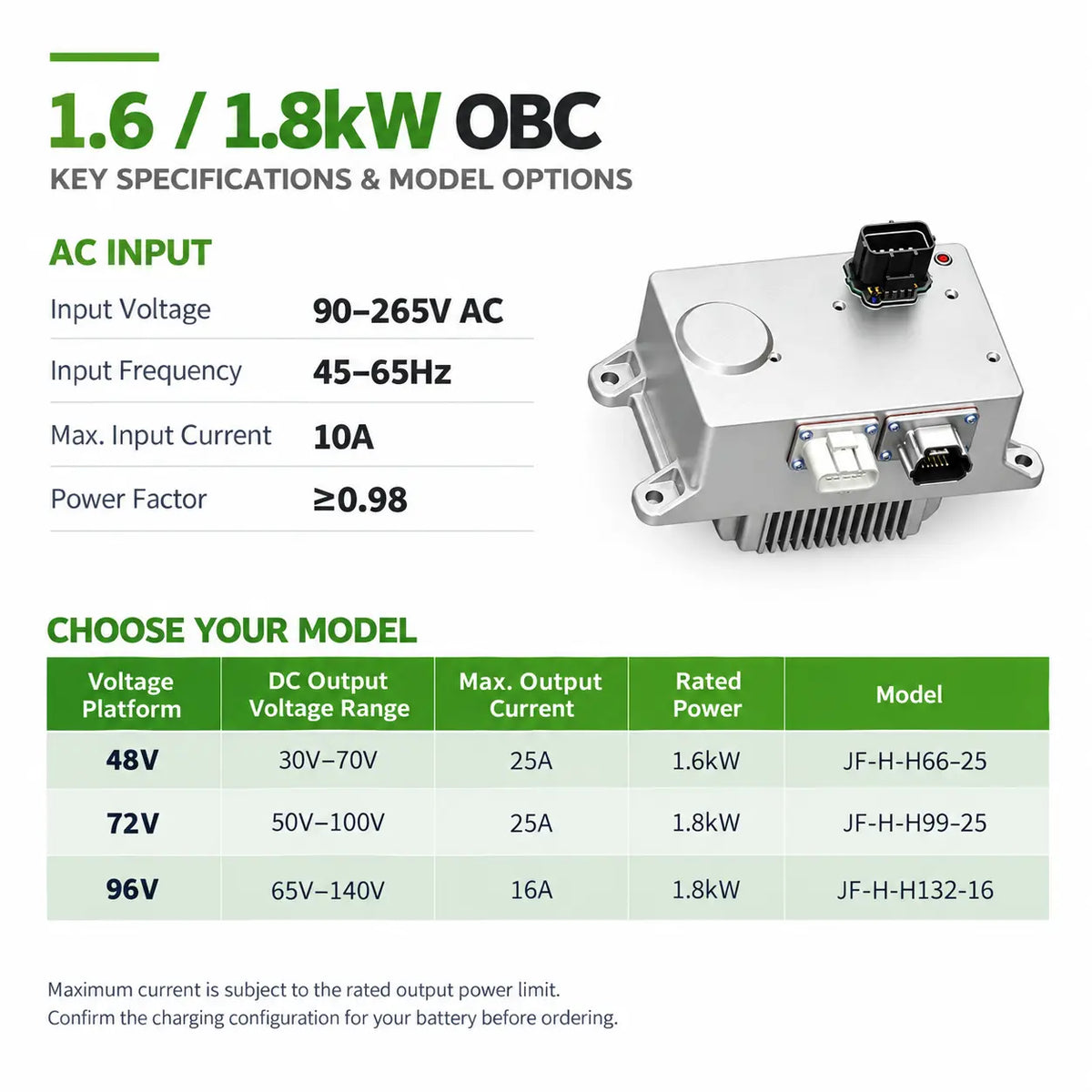
Choose a 48V 1.6kW, 72V 1.8kW or 96V 1.8kW OBC battery charger, with either CAN control or enable control to suit your system.
The series features 90–265V AC input, full-load efficiency above 93%, fan cooling and an IP67-rated enclosure. AmpBird helps you match the output configuration and control method to your battery before ordering.

Before You Order
Send us the following details to confirm your charger configuration:
- Battery chemistry: Li-ion or LifePO4?
- Series No. of the battery:
- Max. charging voltage:
- Control method: CAN or Enable?
- Baud rate:
- AC input voltage:
For a replacement on-board charger, also include the original charger’s nameplate and connector photos.
Technical Specifications
| Parameter | Specification |
|---|---|
| Rated Output Power | 48V model: 1.6kW; 72V / 96V models: 1.8kW |
| AC Input Voltage Range | 90–265V AC |
| DC Output Voltage Range | 48V model: 30–70V; 72V model: 50–100V; 96V model: 65–140V |
| Maximum Charging Current | 48V / 72V models: 25A; 96V model: 16A |
| Control Method | CAN Control or Enable Control — select one when ordering |
| Dimensions (W × D × H) | Approx. 203 × 135 × 125mm |
| Weight | Approx. 3.6kg |
| Protection Rating | IP67 |
| Cooling Method | Fan cooling |
| Operating Temperature | −40°C to +55°C |
| Full-Load Efficiency | >93% |
| Input Frequency | 45–65Hz |
| Maximum AC Input Current | 10A |
Input power note: The wide AC input range does not guarantee full rated output at every input voltage. For 110V or 120V installations, confirm available output power before ordering.

CAN Control or Enable Control
Each charger is supplied with one control method only. These are separate configurations, not switchable modes.
| Control Option | How It Works | What to Provide |
|---|---|---|
| CAN Control | Charging is controlled through compatible CAN communication with your BMS or controller. | Battery specifications, CAN protocol and baud rate |
| Enable Control | We preset the charger to your battery specifications. An external enable signal activates charging without BMS-to-charger CAN communication. | Battery specifications, required charging settings |
Choose CAN control when your system requires communication-based charging control and the protocol can be matched.
Choose enable control when you want a preconfigured charging setup without CAN integration. The battery still requires appropriate BMS protection, and the enable interface must match your control circuit.
CC / CP Function
CC/CP is used for communication between the vehicle-side charging system and the AC charging station (EVSE), including connection confirmation and charging permission/current information.
This function is typically relevant when the vehicle is charged through an EV charging inlet, such as a Type 2 connection. If your system already handles these signals through a separate EVCC or vehicle controller, the OBC itself may not need CC/CP.
1.8kW OBC: CC/CP is not supported.
3.3kW & 6.6kW OBC: The hardware supports CC/CP, but the function is not enabled in the standard software. Please specify CC/CP requirements before ordering.
Built-In Protection
-
Input overvoltage and undervoltage protection.
-
Output overvoltage, overcurrent and short-circuit protection.
-
Battery reverse-polarity protection.
-
Internal overtemperature protection: derating starts at 85°C; shutdown at 90°C.
-
CAN communication fault protection and BMS communication-loss shutdown — CAN version only.
Package Contents & Wiring
The charger comes with matching mating connectors only. Cables, wiring harnesses, AC mains plugs and DC battery-side plugs are not included. Customers must provide and wire suitable cables and plugs for their installation.
Need a custom wiring harness or plug configuration? Contact AmpBird before ordering for assistance.

Choose Your Output Configuration
| Specification | 48V Version | 72V Version | 96V Version |
|---|---|---|---|
| Model | JF-H-H66-25 | JF-H-H99-25 | JF-H-H132-16 |
| Rated Output Power | 1.6kW | 1.8kW | 1.8kW |
| Output Voltage Range | 30–70V DC | 50–100V DC | 65–140V DC |
| Maximum Output Current | 25A | 25A | 16A |
Select by your battery’s required charging voltage and allowable current, not nominal voltage alone. Maximum output current is subject to the rated power limit and operating conditions.
Suitable Applications
The 3.3kW OBC can be considered for applications such as:
- Electric vehicles
- Classic car EV conversions
- Custom EV projects
- Electric utility vehicles
- Lithium battery-powered vehicles
- Battery pack integration projects
- Vehicle systems using Orion or ZEVA BMS
- Custom CAN-controlled charging systems
Shipping: Ships from China by express air. Estimated Delivery Time: 7–10 days. Import duties and taxes are not included.
Warranty: 1-Year Limited Warranty
QUESTIONS ET RÉPONSES